
The Oxford Street Development Corporation (OSDC) Board met for the first time today, a key moment for a project that has been discussed for years but is now moving into delivery. With the Corporation legally established from 1 January 2026, the meeting focused less on vision statements and more on the practical question of how the OSDC becomes operational quickly, while setting the foundations for long-term governance, investment and stewardship.
Oxford Street’s importance was repeatedly framed in national and global terms during the session. The Board heard that Oxford Street alone generates around 1% of the UK’s GDP, as it sits at the centre of the West End. The scale of the opportunity, and the scrutiny that will come with it, were clear throughout.
What the first meeting focused on
The first Board meeting was primarily about making the Oxford Street Development Corporation operational and setting expectations for delivery. Members agreed a series of foundational governance and financial arrangements, enabling the Corporation to function as a statutory body from the outset, and noted the draft budget for 2026 to 2027.
Alongside these formal decisions, early discussion also focused on how the Board will work in practice, including the need for regular engagement beyond formal meetings, clear committee structures, and effective use of members’ specialist expertise as design and delivery activity accelerates.
The Mayor’s message, ambition and responsibility
The Mayor used the meeting to underline why the OSDC has been established now, framing Oxford Street as a project of national and global significance rather than a conventional high street intervention. He acknowledged the structural pressures facing the street, from changes in retail behaviour to post-pandemic patterns, while emphasising its continued economic importance.
He also highlighted the role that pedestrianisation and high-quality public realm could play in restoring footfall and confidence, drawing on international examples. Describing the Board as “Avengers assembled”, the Mayor struck a light tone while reinforcing a serious point, the Corporation now has significant powers, and with them comes a clear responsibility to deliver tangible change.
Delivery, footfall and confidence
A consistent theme from Board members was the importance of delivery pace and credibility. Contributions emphasised that Oxford Street’s recovery depends on increasing footfall and improving perceptions, both in London and internationally, and that high-quality design must be matched by strong management, safety and stewardship.
Consultation, design and next steps
Whilst a live consultation is currently underway on the highway and traffic changes required to enable pedestrianisation in the Oxford Street West section, and due to close on 16 January, members were briefed on the ambitious delivery timetable.
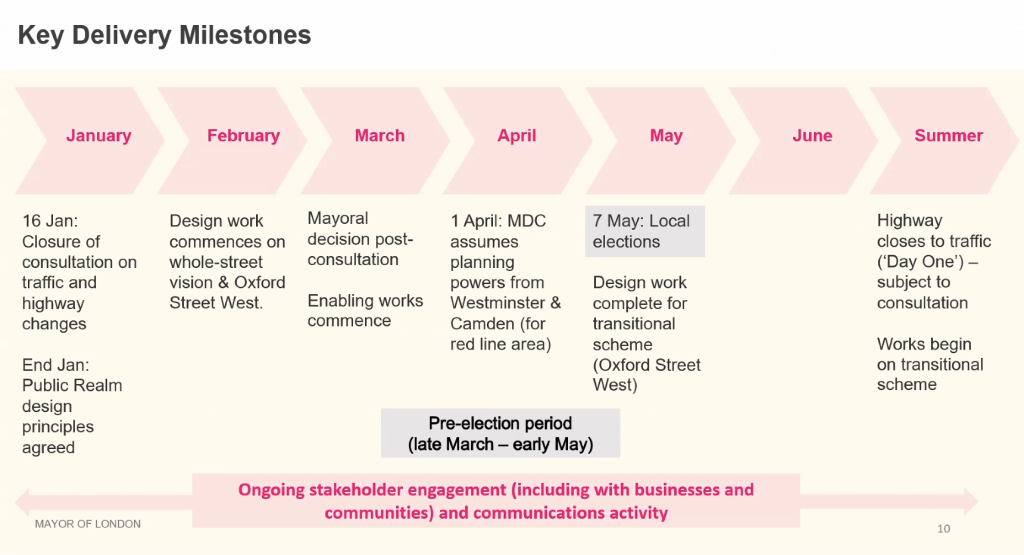
A key principle highlighted was the need to deliver change quickly while avoiding prolonged disruption, ensuring that Oxford Street remains functional and active throughout the transformation process.
Stakeholder engagement as a delivery priority
Stakeholder engagement emerged as a central delivery priority rather than a secondary consideration. Board members stressed the importance of putting clear engagement structures in place early, particularly for residents, local communities and those affected by changes to transport and accessibility.
Discussion highlighted the need for inclusive engagement that treats residents as potential partners and ambassadors, and reflects the fact that Oxford Street’s transformation will have impacts well beyond the Corporation’s formal boundary. Ensuring coherence with wider West End projects and movement patterns was seen as essential to long-term success.
Practical considerations raised
Members also highlighted a number of practical factors that will shape outcomes on the ground, including the role of food and beverage in driving evening activity, the need to plan utilities and infrastructure to avoid repeated disruption, and the importance of building security and operational requirements into the public realm design from the outset. There was also interest in greater clarity on early priorities to help Board members support delivery in the initial phase.
Who is on the OSDC Board
The OSDC Board brings together leadership from local government and the GLA with independent expertise spanning retail, culture, fashion, hospitality, finance, governance and growth.
Chair and executive leadership
Scott Parsons, Chair
Retail and real estate leader, with senior roles at Landsec and Unibail-Rodamco-Westfield, bringing experience of managing major assets through market disruption.
Nabeel Khan, Chief Executive
Former Corporate Director for Growth and Environment at the London Borough of Lambeth, with a track record across planning, regeneration, transport and public realm policy.
Philip Graham, Interim Chief Executive
Executive Director for Good Growth at the Greater London Authority, overseeing the OSDC’s establishment phase and early mobilisation.
Independent members
Keith Edelman
Business executive across retail, leisure and property, best known for overseeing development of the Emirates Stadium as Managing Director of Arsenal FC, and former Director at the London Legacy Development Corporation.
Asma Khan
Restaurateur and social entrepreneur, founder of Darjeeling Express in Soho, known for combining hospitality with strong social value and community impact.
Caroline Rush CBE
Former Chief Executive of the British Fashion Council, closely associated with London Fashion Week and sector leadership in British fashion and creative industries.
Es Devlin OBE
Internationally recognised designer working across theatre, music and public space, bringing a strong creative perspective on experience, identity and place.
Kate Willard OBE
Chair and Chief Executive of the Thames Estuary Growth Board, with expertise in long-term growth strategy and infrastructure-led place transformation.
Dr Margaret Casely-Hayford CBE
Lawyer and business leader with expertise in planning legislation and board governance, and a long-standing advocate for diversity and inclusive leadership.
Emir Feisal
Chartered accountant specialising in transformation and public-sector governance, with non-executive roles across national public bodies.
Local authority and GLA members
Cllr Adam Hug
Leader of Westminster City Council
Cllr Richard Olszewski
Leader of Camden Council
Stuart Love
Chief Executive of Westminster City Council
Manisha Patel
Director of ASC Governance, Operations and Oxford Street at Westminster City Council
Howard Dawber OBE
Deputy Mayor for Business and Chair of London and Partners, with extensive private sector experience, including senior leadership at Canary Wharf Group.
Business representation, ex officio
Dee Corsi
Chief Executive of New West End Company, representing the business improvement district and bringing expertise in destination management, public realm, safety and advocacy.
Planning powers and the new decision-making route
While the Corporation now exists in law, full planning powers are expected to transfer from April 2026, subject to statutory processes. The intention is that planning applications within the OSDC boundary will then be determined through a dedicated OSDC Planning Committee.
Public realm and pedestrianisation proposals—transport and highway arrangements currently in consultation—are expected to form a core part of the Corporation’s early delivery agenda.
This all unfolds against the backdrop of local elections in May 2026. While borough-level political change is possible, the establishment of a Mayoral Development Corporation aims to provide continuity.
What this means for stakeholders
The first Board meeting was not framed as a ceremonial beginning, it was framed as a mobilisation. Governance arrangements are being put in place, consultation activity is live, design work is underway, planning powers are being prepared, and delivery timelines are ambitious.
The message from the room was consistent, this is a global project, the opportunity is enormous, and delivery will depend on credibility, stakeholder engagement, operational excellence and a clear focus on what makes destinations work, people, footfall, safety, experience and stewardship.
Keeping up to date
At Concilio, we are already supporting clients on how to navigate this new governance framework and provide regular updates on the plans for the Oxford Street transformation.
If you would like to sign up to receive our regular OSDC updates, with our first issue from yesterday on the board announcement, or discuss how we can support your project, from early-stage strategy through stakeholder engagement and planning application navigation, please contact us at osdc@conciliocomms.com or via our website.