

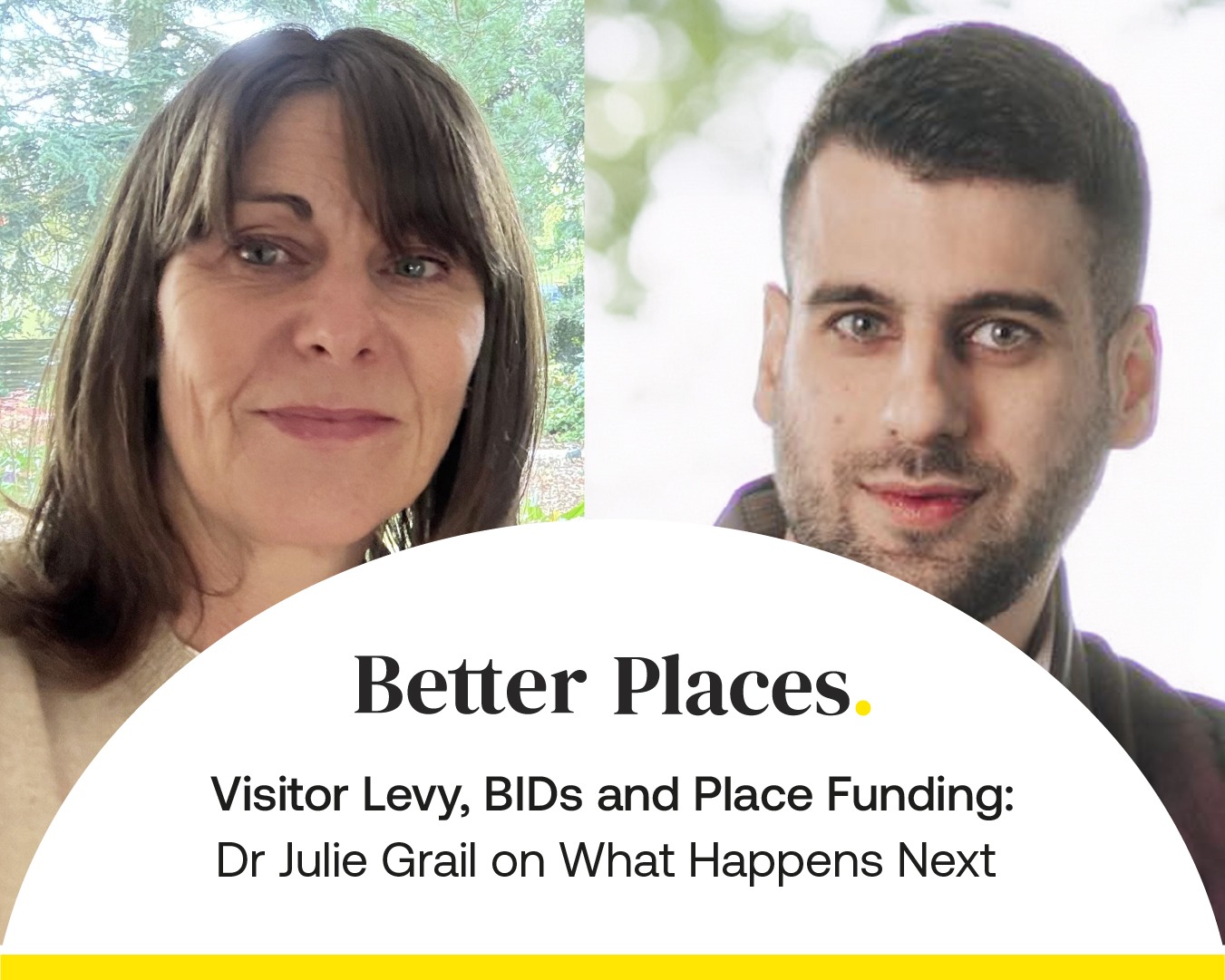
In the latest episode of the Better Places Podcast, Concilio’s Yiannis Sophocleous is joined by Dr Julie Grail, founder of The BIDs Business and one of the UK’s foremost experts on Business Improvement Districts, to discuss the proposed overnight visitor levy and what it could mean for cities across England.
With the government consultation now closed, the debate has intensified. The idea of a visitor levy is not new internationally, but its introduction in England raises important questions about design, governance and timing.
At the heart of the discussion is a central tension. Can a visitor levy be structured as a genuine growth mechanism that unlocks investment in public realm, destination management and city centre competitiveness, or will it be perceived as simply another tax on an already pressured hospitality sector?
Dr Grail reflects on the reaction from the industry, highlighting concerns around cost pressures, competitiveness and administrative burden. She also explores the importance of ringfencing and transparency, and whether businesses can have confidence that funds raised would be reinvested in ways that directly support the visitor economy.
The episode considers lessons from international examples and from closer to home, including the experience of accommodation BIDs in regional cities. While there are models that demonstrate how visitor contributions can support growth, scale, governance and local context all matter.
Beyond the levy itself, the conversation broadens into the evolving role of BIDs in a period of political and economic uncertainty. With businesses facing rising costs and local authorities under continued financial pressure, the importance of strong place based partnerships has never been clearer. The discussion touches on innovation in BID governance, including digital voting, and the case for expanding property owner involvement in place management.
This episode offers a balanced and timely exploration of one of the most significant funding debates currently facing English cities. For those working in hospitality, planning, property, local government or place leadership, it provides valuable insight into both the risks and the opportunities ahead.